
Companies often evaluate AI by asking what it can do.
Can an AI agent research a company?
Can it write content?
Can it analyze data?
Can it update a CRM?
Can it prepare a deployment?
These questions are useful, but they do not tell us whether AI will actually improve a business.
A more practical question is:
Where is work spending too much time waiting?
In many organizations, the biggest productivity problem is not that people cannot complete a task. It is that work sits between tasks, teams, approvals, and systems.
A prospect waits for research.
A campaign waits for content.
A feature waits for QA.
A decision waits for somebody to create the follow-up task.
A deployment waits for verification.
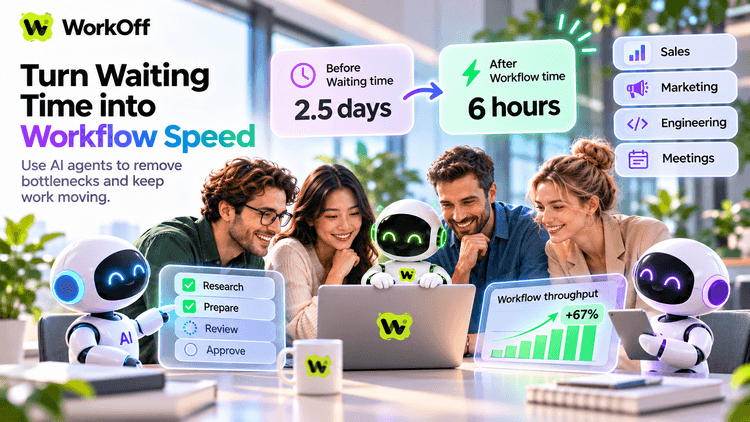
This waiting time is often where AI agents can create meaningful business value.
Instead of adding AI to every process, companies can look for workflows where work repeatedly stops, identify the reason, and delegate a bounded part of that process.
A business process may contain only a few hours of actual work and still take several days to complete.
Imagine a simple marketing workflow:
Research: 2 hours
Draft: 1 hour
Review: 30 minutes
Publication: 15 minutes
The actual work takes less than four hours.
But the article may still take five days to publish.
Why?
Research waits for someone to start it.
The draft waits for research.
The review waits for a manager.
Publication waits for another team member.
The bottleneck is not necessarily the difficulty of the work.
It is the amount of time between the steps.
The same pattern appears in sales, engineering, operations, customer support, and many other functions.
This is why a useful AI strategy should focus not only on task automation, but also on workflow movement.
An AI-native workplace can help by allowing AI agents to participate in the same processes, tools, conversations, and tasks as human team members.
The objective is not to remove humans from the workflow.
It is to remove unnecessary waiting.
Sales teams spend a surprising amount of time preparing for conversations.
Before a representative contacts a prospect, somebody may need to:
These tasks matter.
But a salesperson does not always need to perform them personally.
If research takes half a day, the opportunity waits half a day.
If 20 opportunities require the same preparation, the delay compounds.
This is where AI agents for business can take responsibility for clearly defined preparation work.
For example, an AI agent could receive a list of target accounts and return:
The salesperson can then review the result and decide what to do next.
The key measurement is not how many searches the AI performed.
It is whether the sales team reaches qualified conversations faster.
If average preparation time falls from three hours to 30 minutes, the workflow has improved.
Marketing teams already use AI for writing, ideation, and research.
But isolated AI assistance does not automatically improve the whole process.
A campaign might require:
Market research → Keyword analysis → Brief → Draft → Creative → Approval → Publication → Distribution
If every stage still waits for someone to manually start the next one, the company has accelerated tasks without necessarily accelerating the workflow.
This is where coordinated AI teams for business can become more useful.
Different agents can specialize in different parts of the process.
One agent can research.
Another can analyze opportunities.
Another can prepare content.
Another can organize supporting material.
A coordinating agent can help move work through the sequence while humans remain responsible for important decisions.
The result should be visible in business metrics.
For example:
AI becomes valuable when the workflow moves faster, not simply when more content is generated.
Engineering teams provide one of the clearest examples of why task speed and workflow speed are different.
AI coding tools can help developers write software faster.
But software still has to move through:
requirements → implementation → review → testing → QA → deployment → verification
Suppose implementation becomes 50 percent faster.
That sounds excellent.
But if every feature then spends two days waiting for QA, overall delivery may barely improve.
The bottleneck has simply moved.
This means engineering teams should examine the entire delivery process before deciding where AI can help most.
The right use case might be:
The objective is not maximum AI activity.
It is shorter and more reliable delivery cycles.
Meetings are another common source of hidden waiting.
A call ends with three decisions:
Update the landing page.
Test a new acquisition channel.
Contact 20 target customers.
Everybody agrees.
Then the meeting ends.
The notes are saved.
Nothing else happens.
Several hours or even days later, someone creates the tasks, assigns owners, and follows up.
The meeting itself was not the bottleneck.
The bottleneck was the handoff between decision and execution.
An AI agent can potentially help by:
The real metric is simple:
How quickly does a decision become an owned action?
A better transcript is useful.
A faster path from decision to execution is more valuable.
Businesses often measure how long a person spends actively working on something.
But another useful metric is queue time.
Queue time is the period when work is ready to move but is waiting for the next step.
Consider this process:
Research takes 30 minutes.
Review takes 15 minutes.
Approval takes 5 minutes.
Total active work: 50 minutes.
But research waits eight hours for review.
Review waits another day for approval.
The process takes almost two days even though less than one hour of actual work occurred.
AI agents can often create value by reducing these gaps.
An agent does not necessarily need to replace the human reviewer.
It might prepare the review package immediately, organize the evidence, and notify the right person.
That can remove several hours of waiting without removing human control.
Not every slow process should be automated.
A useful AI workflow usually has several characteristics.
A recurring bottleneck creates repeated cost.
If the same delay happens every day, improving it can produce significant cumulative value.
The agent should know what it receives and what it is expected to produce.
For example:
Input: 50 target companies.
Output: qualified companies with decision-makers, evidence, and relevant context.
Clear outcomes make delegation easier to measure.
Businesses should maintain human oversight where mistakes could create meaningful risk.
AI can prepare, research, test, analyze, and coordinate while people retain authority over consequential actions.
An agent should have access only to what it needs.
A research agent may need web search and internal knowledge.
It probably does not need permission to deploy production software.
A content agent may prepare a post.
It does not necessarily need permission to publish it automatically.
Effective AI delegation depends on matching authority to responsibility.
An AI system may produce hundreds of outputs and still fail to improve the business.
That happens when activity becomes the metric.
Businesses should instead look at throughput.
Throughput answers a different question:
How many useful outcomes are actually completed?
Suppose a marketing team publishes eight quality articles per month before using AI.
After adding agents, it publishes 14 with the same team and similar quality.
That is improved throughput.
Suppose a sales team qualifies 30 accounts per week.
After delegation, it qualifies 70 while salespeople spend more time in conversations.
That is improved throughput.
Suppose engineering reduces the average feature delivery cycle from 12 days to 8.
That is measurable improvement.
The AI system does not need to look impressive.
The process needs to perform better.
There is also a risk in overengineering AI workflows.
Companies sometimes assume that more agents mean more automation.
But every additional agent creates coordination requirements.
Context has to move between agents.
Results have to be reconciled.
Responsibility has to remain clear.
A simple workflow may only need one agent.
A more complex process may benefit from several specialized agents.
The architecture should match the bottleneck.
For example:
Research → Analysis → Human Review
may be enough.
Another workflow may require:
Research Agent → Strategy Agent → Execution Agent → QA Agent → Human Approval
Both can be valid.
The right design is the simplest one that reliably improves the process.
A company does not need a large AI transformation program to begin.
Start by finding one recurring delay.
Ask:
Where does work wait?
Why does it wait?
What information is missing?
Which step is repetitive?
Which part requires human judgment?
Which part could AI prepare or execute?
Then define one measurable experiment.
For example:
"Reduce account research turnaround from four hours to one hour."
"Reduce campaign preparation from five days to three."
"Convert meeting decisions into prepared tasks within five minutes."
"Reduce QA queue time by 30 percent."
These targets are much more useful than:
"Use more AI."
They connect AI directly to operations.
AI adoption does not have to begin with a new tool or a new agent.
It can begin with a queue.
A delay.
A handoff.
A process that repeatedly stops for the same reason.
Find that point first.
Then decide whether AI can safely take responsibility for part of the work.
The strongest AI use cases are often not the most futuristic ones.
They are the ones where a team finishes more meaningful work with less waiting.
