
Artificial intelligence has already become part of everyday business.
Teams use AI to write content, analyze information, summarize documents, generate code, research competitors, and prepare ideas.
But most AI usage still follows the same pattern.
A person opens an AI tool.
They explain the task.
The AI generates an answer.
Then the person manually takes that answer and moves it into the applications where the real work continues.
This is useful, but it leaves humans responsible for connecting every step.
A new generation of AI systems is beginning to change that model.
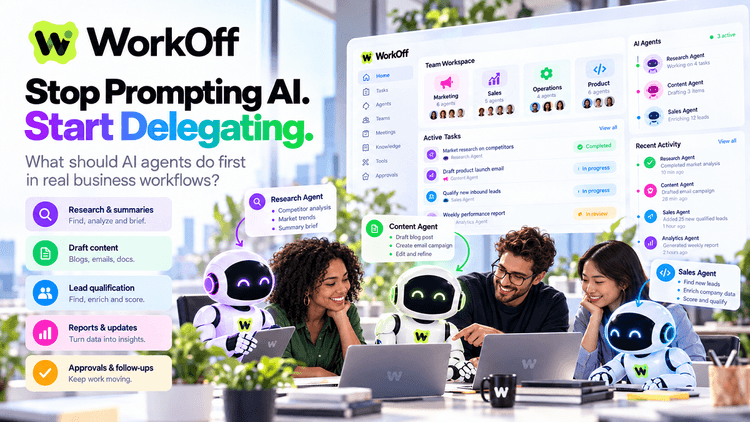
Instead of simply answering questions, AI agents can increasingly receive objectives, work through multiple steps, use approved tools, collaborate with other agents, and return completed work for human review.
The transition is significant.
Businesses are moving from AI assistance toward AI execution.
Consider a typical business request:
"Write a follow-up email for this prospect."
An AI assistant can complete that request in seconds.
But the employee may still need to:
The AI handled one step.
The employee still managed the workflow.
Now consider a different request:
"Research this account, identify the most relevant decision-maker, prepare personalized outreach, and bring the result back for approval."
This is no longer simply content generation.
It is delegation.
That distinction is becoming central to platforms such as WorkOff, which are designed around humans and AI agents working together inside the same operational environment.
The biggest constraint inside many companies is not a lack of information.
It is a lack of execution capacity.
Teams already know that they should:
The problem is time.
People have limited attention, and every additional task introduces coordination overhead.
AI agents create the possibility of increasing execution capacity without requiring humans to manually operate every step.
The real opportunity is therefore not simply producing more AI-generated text.
It is completing more useful work.
Businesses do not need to begin by giving AI complete control over complex processes.
A better starting point is work that is:
This creates a practical path to adoption.
AI performs more of the preparation and execution.
Humans continue making the important decisions.
Research is one of the most natural tasks to delegate first.
Companies constantly need information about:
Employees often spend hours searching, opening pages, comparing information, and organizing findings.
AI agents can accelerate this process.
Instead of asking AI isolated research questions, a team can define a broader objective.
For example:
"Compare the five main competitors in this market and identify differences in positioning, pricing, target customers, and product capabilities."
The agent can gather information, structure it, and prepare a result for review.
The person then spends more time evaluating the findings and less time collecting them.
B2B sales is particularly suitable for agent-based workflows because so much of the work happens before a salesperson has a meaningful conversation.
A typical process may involve:
These activities are necessary, but many are repetitive.
An AI agent can handle significant parts of the preparation.
The salesperson remains responsible for the relationship, qualification, negotiation, and final commercial decisions.
This creates a better division of labor.
AI handles more of the research.
Humans spend more time selling.
Marketing teams already use generative AI extensively.
But the workflow often remains fragmented.
One prompt is used for competitor research.
Another generates keywords.
Another prepares an outline.
Another writes a draft.
Another creates campaign ideas.
The marketer manually coordinates everything.
AI agents can connect these activities around a shared objective.
Imagine asking:
"Prepare a campaign for our new product launch."
That objective could involve:
The value is not simply that AI can write content.
The value is that several connected tasks can move forward together.
Complex business objectives often require different capabilities.
Human organizations solve this through specialization.
Marketing teams include researchers, writers, analysts, and campaign specialists.
Engineering teams include developers, QA specialists, reviewers, and technical leads.
Sales organizations include researchers, prospecting specialists, SDRs, and account executives.
AI workflows can follow a similar structure.
Instead of relying on one general-purpose assistant, businesses can use coordinated specialist agents.
For example, an AI marketing workflow might include:
The lead agent coordinates the overall objective while specialist agents focus on individual areas.
This is the model behind AI Teams in WorkOff, where multiple agents can collaborate around a shared goal instead of producing disconnected outputs.
Software development is another area where delegation is becoming increasingly practical.
AI is already commonly used to:
Agent-based workflows can extend this further.
For example:
A Developer Agent works on implementation.
A QA Agent tests the result.
A Review Agent checks the changes.
A Lead Agent coordinates progress.
A human engineer can remain responsible for architecture, security, production decisions, and final approval.
This is important.
The objective is not necessarily autonomous software development.
The objective is to reduce repetitive execution around human engineering decisions.
Meetings create a surprising amount of additional work.
After a meeting, someone may need to:
Current AI meeting tools already summarize conversations.
But AI agents could connect the meeting directly to execution.
Imagine a team discussing a competitor and saying:
"We need a comparison before Friday."
Instead of simply recording that statement as an action item, an AI agent could receive the assignment, perform the research, structure the comparison, and return the result.
The meeting moves directly into execution.
That is much more valuable than transcription alone.
Many business functions contain small tasks that individually consume little time but collectively create significant overhead.
Examples include:
These are exactly the kinds of workflows where AI agents can provide leverage.
A person defines the goal and boundaries.
The agent handles more of the repetitive execution.
As AI agents become more capable, businesses face a new challenge.
Generating an answer is relatively low risk.
Taking an action can have consequences.
Consider the difference between:
"Draft an email."
and:
"Send this email to the customer."
Or:
"Suggest a database update."
and:
"Modify the production database."
The second action in each example requires much stronger controls.
This is why AI delegation should not automatically mean unlimited autonomy.
Many workflows can be mostly automated while still keeping people involved at important checkpoints.
For example, an AI sales agent could:
and then pause before sending the message.
A marketing agent could:
and then request approval before publishing.
An engineering agent could:
while deployment remains a human decision.
This creates a practical model:
AI performs the work. Humans retain authority over consequential actions.
A capable AI agent should not automatically have access to every company tool.
Access should match responsibility.
A research agent may need search and document tools.
A marketing agent may need access to content and analytics systems.
A development agent may need repository access.
That does not mean every agent should be able to use every system.
Businesses need to define:
This creates clear operational boundaries.
AI agents can consume resources.
They may use:
A workflow that continues running without limits can create unexpected costs.
Budgets solve part of this problem.
Teams can define how much an agent or workflow is allowed to consume before stopping or requiring intervention.
That makes AI execution more predictable.
For businesses to delegate meaningful work, they need to understand what agents are doing.
Visibility can include:
This is especially important when multiple agents collaborate.
If something goes wrong, the company needs to understand what happened.
If something works well, the company needs to understand how it happened so the workflow can be repeated.
Businesses do not need to redesign an entire organization around AI agents.
A better approach is to start with one workflow.
Choose something measurable.
For example:
Sales
Research 30 target accounts and prepare personalized outreach.
Marketing
Analyze five competitors and create a content plan.
Engineering
Implement a small feature, run tests, and prepare the result for review.
Research
Compare several vendors and prepare a structured recommendation.
Then evaluate the result.
Ask:
This turns AI adoption into an operational experiment rather than an abstract technology project.
The first generation of workplace AI was about generation.
What can AI create?
Then businesses became interested in automation.
What can AI automate?
AI agents introduce a different question.
What can we safely delegate?
That question is more useful because it combines capability with responsibility.
The agent needs enough autonomy to create value.
The business needs enough control to trust the process.
AI is unlikely to remain a separate window that employees open whenever they need help.
As agents become more capable, they will increasingly participate inside the workflows where work already happens.
That may include:
The workplace therefore begins changing from software designed only for humans to software designed for humans and AI agents working together.
AI agents do not need to replace entire departments to create meaningful business value.
They simply need to take responsibility for more of the work that currently consumes human time.
Research.
Preparation.
Execution.
Coordination.
Follow-up.
Humans can continue focusing on the areas where their judgment matters most:
Companies that learn how to divide work effectively between humans and AI may gain significantly more execution capacity without giving up control.
For teams that want to experiment with real AI delegation, WorkOff Early Access provides an opportunity to test AI agents and coordinated AI workflows in practice.
The next stage of workplace AI is not simply about asking machines better questions.
It is about learning what work we can confidently give them to do.
