Artificial intelligence has already changed how people research, write, analyze information, and solve everyday business problems.
But in most companies, AI is still used as a separate tool.
A person opens a chatbot, asks a question, receives an answer, and then manually moves that information into the systems where the real work continues.
That model is useful, but it creates a gap between AI assistance and actual execution.
A new generation of AI platforms is trying to close that gap.
Instead of asking AI to simply provide answers, businesses are beginning to experiment with AI agents that can receive tasks, use approved tools, collaborate with other agents, and work alongside human teams.
The result is the emergence of something much closer to an AI workforce.
Chatbots have been extremely successful because they make advanced AI simple to use.
You type.
AI responds.
But workplace processes rarely consist of a single question and a single answer.
A typical business task may involve:
A standalone chatbot can assist with individual steps, but people still need to connect those steps together.
That creates friction.
Employees become the integration layer between AI and the rest of the organization.
AI agents introduce a different interaction model.
Instead of:
"Write an email for this prospect."
a company may eventually delegate something closer to:
"Research this account, identify the most relevant contact, prepare a personalized message, and send it for approval."
This is a significant change.
The first request asks AI to create content.
The second gives AI responsibility for part of a workflow.
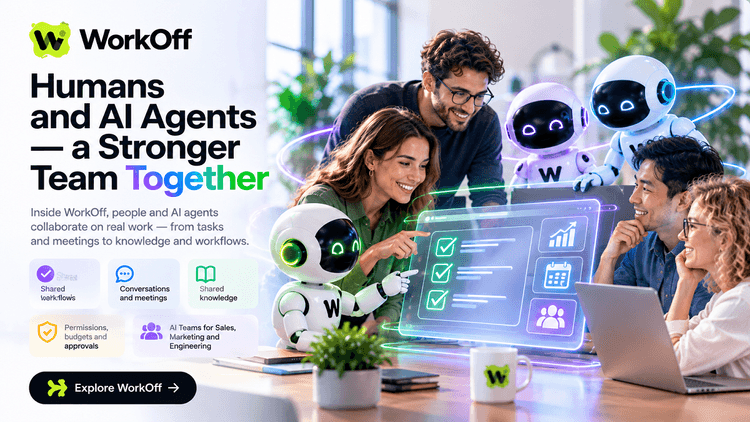
Platforms such as WorkOff are being built around this idea - giving humans and AI agents a shared workplace where tasks, conversations, tools, meetings, and knowledge can exist in one environment.
The goal is not simply to make AI smarter.
The goal is to make AI more useful inside real business processes.
An AI workforce can be understood as a group of AI agents with different roles, responsibilities, tools, and boundaries.
In many ways, the structure resembles a human team.
One agent may specialize in research.
Another may focus on writing.
Another may analyze data.
Another may review results.
A lead agent can coordinate the work between them.
Instead of one general-purpose AI trying to handle every task, specialist agents can focus on particular parts of the process.
This model becomes especially interesting when the agents can collaborate with human employees rather than operating as a separate automation layer.
Human teams are specialized for a reason.
A marketing department may include:
A sales organization may include:
An engineering organization may include:
There is no reason to assume that every AI workflow should be handled by one general-purpose bot.
Specialized agents can be configured around specific responsibilities.
That makes it possible to build teams where each agent has:
Sales provides a useful example.
A typical prospecting process might include:
Traditionally, a salesperson may perform most of these tasks manually.
With an AI workforce, different agents can participate in different stages.
Finds companies that match a defined ideal customer profile.
Studies the company, market, decision-makers, and relevant context.
Uses the research to prepare personalized communication.
Coordinates the process and reviews the work before it moves forward.
The human sales team remains responsible for strategy, judgment, relationships, and important decisions.
AI handles more of the repetitive execution.
Marketing workflows also contain many connected tasks.
A campaign may require:
These activities are related, but they require different kinds of work.
An AI marketing team could divide the process between several specialized agents.
A research agent analyzes the market.
A content agent prepares materials.
An SEO or GEO specialist works on visibility.
A lead agent keeps the overall objective in focus.
The important difference is coordination.
Instead of receiving isolated AI outputs, the company can work with a connected workflow.
Software engineering has already become one of the most active areas for AI adoption.
Developers use AI for:
The next step is coordination between multiple specialist agents.
An engineering workflow might involve:
Works on implementation.
Checks functionality and identifies problems.
Reviews changes and provides feedback.
Coordinates tasks and reviews progress.
The result is not necessarily autonomous software development.
It is a new way to combine human engineers with AI specialists.
One of the biggest challenges with AI in business is context.
Real work depends on information scattered across:
If AI operates in isolation, employees have to continuously supply that information manually.
That reduces efficiency and creates inconsistencies.
A shared workspace can provide agents with the context appropriate to their role.
This does not mean every AI agent should see everything.
The opposite is usually more practical.
Agents should receive the information they need while respecting boundaries between projects, teams, users, and sensitive data.
The more AI can do, the more important control becomes.
A chatbot that generates a paragraph creates relatively little operational risk.
An AI agent capable of interacting with company systems is different.
Businesses need to know:
This is why governance is likely to become a major part of enterprise AI adoption.
WorkOff, for example, is designed around controlled agent activity with features such as permissions, budgets, isolated execution environments, approvals, and activity tracking.
The underlying principle is straightforward:
Give AI enough autonomy to be useful, but keep important decisions under human control.
Work is not just a collection of task lists.
Teams also communicate, meet, share knowledge, review work, and make decisions.
For AI agents to become useful members of a team, they need to participate in these activities as well.
That can include:
This is where the idea of an AI-native workplace becomes more interesting than another isolated AI application.
The workplace itself becomes designed for both humans and AI.
AI meeting assistants are already common.
Most focus on:
But there is a difference between documenting a meeting and participating in the workflow that follows it.
An AI agent that understands the project context can potentially do more.
After a decision is made, the agent may be able to:
This creates a tighter connection between discussion and execution.
The idea of an AI workforce does not require removing people from organizations.
In practice, human involvement becomes even more important in several areas.
People remain responsible for:
AI agents can take on more of the execution that surrounds those activities.
The result is not "humans versus AI."
It is a new division of work.
For the first generation of workplace AI, the primary question was:
How good is the answer?
For the next generation, another question may become equally important:
How much useful work can I safely delegate?
That requires a combination of:
A highly intelligent model without access to the workflow remains an assistant.
An agent that can understand its role and reliably execute within defined boundaries becomes something closer to a teammate.
Many businesses already have more software than they want.
Adding another disconnected AI interface does not necessarily solve the problem.
A shared workspace offers another direction.
Humans and AI agents can operate inside the same environment.
Tasks can move between them.
Knowledge can remain connected.
Important actions can require approval.
Progress can remain visible.
Different AI agents can collaborate instead of producing isolated outputs.
For companies exploring this approach, WorkOff provides a practical example of how the model can be structured.
More information about the platform is available at:
The evolution of workplace AI may follow a relatively simple path.
Employees manually ask AI for help with individual tasks.
AI understands more context and supports repeated workflows.
AI receives tasks and can use approved tools to complete them.
Several specialized agents collaborate around shared goals.
People and agents operate inside the same environment with shared tasks, knowledge, communication, and governance.
Many organizations are still somewhere between the first and second stages.
But the direction is becoming easier to see.
The future of AI at work may not be defined by people spending more time chatting with machines.
It may be defined by people spending less time manually coordinating repetitive work.
AI agents can potentially take responsibility for more research, preparation, monitoring, analysis, and execution.
Human employees can focus more on decisions, creativity, strategy, and relationships.
The software layer between them becomes increasingly important.
That layer needs to answer several questions:
Who is responsible for the task?
What context is available?
Which tools are permitted?
What does the agent need approval for?
How much has it spent?
What happened during the process?
What happens next?
These are not traditional chatbot questions.
They are workplace questions.
And that is why the transition from chatbots to AI workforces could become one of the most important developments in enterprise software.
AI has already demonstrated that it can generate useful content, analyze information, and assist with complex tasks.
The next challenge is operational.
Can AI participate in real workflows?
Can it work with people?
Can multiple agents collaborate?
Can businesses maintain visibility and control?
Can AI move from answering questions to completing meaningful work?
Platforms such as WorkOff are exploring what that future might look like.
The broader trend is clear:
AI is moving from the edge of the workflow toward the center of it.
And as that happens, the line between using an AI tool and working with an AI teammate may become increasingly difficult to see.
