
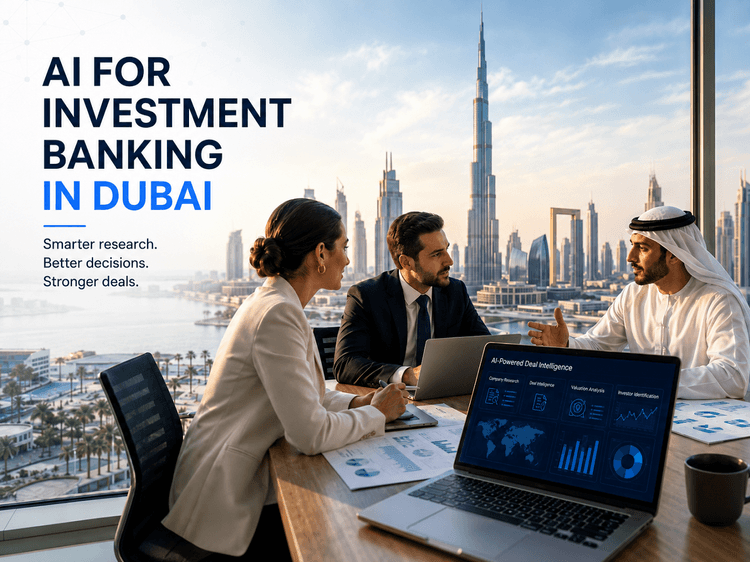
Dubai has spent decades establishing itself as one of the most important financial and business hubs connecting the Middle East, Asia, Africa, and global capital markets. Now, the city is entering another phase of that evolution: artificial intelligence is becoming increasingly embedded in the way financial institutions research opportunities, analyze companies, manage information, and execute transactions.
For investment bankers, advisors, investors, and deal teams operating in the UAE, this shift creates an opportunity to rethink traditionally manual workflows. Purpose-built financial AI platforms such as Brexy are designed for precisely this environment, helping financial professionals move faster across research, company analysis, investment memos, investor identification, and deal execution: https://www.brexy.ai/solutions/investment-banking
Dubai's financial sector is no stranger to technological transformation.
The Dubai International Financial Centre (DIFC) has developed into a major international financial hub serving the Middle East, Africa, and South Asia. More recently, artificial intelligence has moved to the center of its innovation strategy.
In April 2026, DIFC announced its ambition to become the world's first AI-native financial centre, with AI intended to play a role across its business environment, infrastructure, talent development, and broader financial ecosystem.
This is significant for investment banking.
AI is no longer being treated simply as an experimental productivity tool. It is increasingly becoming part of the infrastructure surrounding modern financial services.
For firms operating in Dubai and the UAE, the question is shifting from:
"Should we experiment with AI?"
to:
"How should AI be integrated into the way we research, analyze, and execute deals?"
The trend is already visible.
According to the DFSA's 2025 AI survey, 52% of DFSA-authorised firms reported using AI, compared with 33% in 2024. The regulator also reported that generative AI adoption had risen particularly quickly, while a majority of surveyed firms expected their AI usage to continue increasing.
For financial institutions, this growing adoption is important because investment banking is especially well suited to AI-assisted workflows.
Deal teams work with large volumes of:
The challenge is rarely a lack of information.
The challenge is turning that information into actionable intelligence quickly enough.
Dubai occupies a distinctive position in global finance.
Deal teams operating from the UAE may evaluate businesses and transactions spanning the GCC, Middle East, Asia, Africa, Europe, and other international markets.
This creates complex research requirements.
A banker preparing for a transaction may need to understand businesses operating across several countries, compare companies from different markets, evaluate potential investors, analyze financial performance, and prepare recommendations within a compressed timeframe.
AI for investment banking in Dubai can help reduce the operational burden surrounding these tasks.
Rather than manually working through every document from the beginning, professionals can use specialized financial AI to accelerate the first layer of analysis.
That means reaching the questions that require professional judgment sooner.
Research forms the foundation of almost every investment banking mandate.
Before approaching a client, investor, buyer, or acquisition target, bankers need a strong understanding of the company and its market.
Typical questions include:
In traditional workflows, answering these questions can require hours of manual research.
AI financial research platforms can help bankers search, analyze, summarize, and organize information more efficiently.
For Dubai-based advisory teams working across multiple markets, this can be particularly valuable.
The objective is not simply faster research.
It is faster understanding.
Due diligence is another area where AI can provide meaningful productivity gains.
M&A and capital-markets transactions frequently involve extensive documentation.
Deal professionals may need to review financial information, agreements, management materials, operating data, customer information, and other documents while simultaneously coordinating multiple transaction workstreams.
AI-assisted document intelligence can help teams:
This becomes particularly useful when transaction timelines are tight.
For an investment bank or advisory firm in Dubai, the value is straightforward: professionals can spend less time searching through information and more time determining what that information means for the transaction.
Artificial intelligence also has an increasingly important role around valuation.
Financial modeling itself requires professional expertise, but considerable work happens before the final model is ready.
Analysts need to locate historical financial information, review assumptions, identify comparable businesses, examine precedent transactions, and organize relevant market data.
AI can accelerate this preparation layer.
For example, an analyst evaluating a UAE-based company may need to compare it not only with domestic peers but also with companies elsewhere in the GCC or international markets.
A financial AI platform can help organize the initial research and surface potentially relevant information faster.
The analyst then makes the important decisions:
Which companies are truly comparable?
Which valuation methodology is appropriate?
Are projected growth rates realistic?
How should regional risks be reflected?
Which assumptions require additional testing?
AI accelerates access to information.
The banker provides the judgment.
Investment banking technology has historically improved individual parts of the workflow.
Databases improved research.
Spreadsheets transformed modeling.
Digital data rooms changed due diligence.
AI has the potential to connect many of these stages.
Consider a potential M&A mandate in Dubai.
A modern AI-assisted workflow could move through:
Company Research → Market Analysis → Target Screening → Valuation → Due Diligence → Investor Identification → Deal Materials → Execution
Instead of repeatedly starting from unstructured information, bankers can work from increasingly organized intelligence.
This is where platforms such as Brexy become relevant.
Brexy positions itself as an AI deal partner and financial AI platform built for capital-markets professionals, supporting workflows including company research, investor identification, investment memo preparation, and deal execution.
The broader opportunity is not automating one isolated task.
It is creating an intelligent workflow across the transaction lifecycle.
Dubai's role as an international financial hub also makes AI particularly interesting for cross-border transaction work.
Investment bankers in the UAE frequently operate in an environment where capital, companies, and investors move between multiple regions.
A transaction could involve:
Each scenario creates additional research complexity.
More markets mean more companies.
More companies mean more documents.
More jurisdictions mean more information to evaluate.
Financial AI can help professionals manage that complexity by accelerating information retrieval and analysis.
This does not remove the need for regional expertise.
It makes regional expertise more scalable.
M&A is fundamentally dependent on information.
Buyers want to understand targets.
Sellers want to understand potential buyers.
Advisors need to understand valuation.
Investors need to understand risk.
Management teams need to understand strategic alternatives.
AI can potentially make each stage more efficient.
For M&A advisors in Dubai, practical applications may include:
The result can be a deal team capable of investigating more possibilities without increasing manual workload at the same rate.
That can create a meaningful competitive advantage in a market where responsiveness matters.
Financial institutions cannot adopt AI purely on the basis of speed.
Governance, security, explainability, oversight, and data management are critical considerations.
The DFSA has emphasized issues including AI governance, explainability, third-party risk, cybersecurity, and responsible oversight as adoption across financial services increases.
This distinction is especially important for investment banking.
An AI-generated answer cannot simply be accepted because it appears convincing.
Bankers still need to understand:
The future of AI in finance therefore depends not only on powerful models, but on trustworthy workflows around those models.
Dubai has already built substantial infrastructure around financial innovation.
DIFC describes itself as an international financial hub for the Middle East, Africa, and South Asia, while its innovation ecosystem includes initiatives focused on FinTech and artificial intelligence.
The next stage could be more significant.
Digital finance made information easier to access.
AI-native finance makes information easier to understand and use.
For investment banking, that could mean moving from manually assembling information toward continuously working with structured financial intelligence.
The difference may fundamentally change the economics of deal execution.
The investment banker of the future is unlikely to disappear behind an automated platform.
Instead, the banker may become significantly more capable.
AI handles more of the information-intensive work.
The professional concentrates on the areas where human expertise creates the greatest value:
Relationships - earning the trust of clients, management teams, and investors.
Judgment - understanding which information actually matters.
Strategy - determining the best course of action.
Negotiation - managing complex interests across a transaction.
Accountability - taking responsibility for the final recommendation.
This creates a partnership between technology and professional expertise.
And in a financial centre as internationally connected and innovation-focused as Dubai, that model is particularly compelling.
As investment banking workflows evolve, specialized platforms are emerging to address the specific needs of financial professionals rather than applying generic AI to highly specialized financial tasks.
Brexy is part of this movement.
Its focus on bankers, investors, advisors, and dealmakers reflects a broader shift toward purpose-built AI infrastructure for capital markets. Brexy's platform is designed to help financial teams research companies, identify investors, prepare investment materials, and accelerate deal execution.
For firms exploring AI for investment banking in Dubai and the UAE, this type of finance-native technology represents a potential bridge between traditional deal expertise and the emerging AI-native financial environment.
Dubai's development as a financial centre has historically relied on connectivity.
Connectivity between East and West.
Connectivity between capital and opportunities.
Connectivity between investors, companies, entrepreneurs, and institutions.
Artificial intelligence introduces another form of connectivity:
the connection between information and action.
For investment bankers, that means reducing the time between discovering an opportunity and understanding it.
Between receiving documents and identifying important findings.
Between starting research and developing a transaction thesis.
Between a client question and an informed response.
As Dubai advances its ambition to become an AI-native financial centre, this capability could become increasingly important.
The future of investment banking in the UAE will still depend on relationships, expertise, trust, and professional judgment.
But those capabilities may increasingly be amplified by intelligent financial infrastructure.
And that could make AI-powered investment banking in Dubai one of the most interesting areas to watch in the next generation of global finance.
Explore Brexy for Investment Banking: https://www.brexy.ai/solutions/investment-banking
Request Demo to discover how AI can support faster financial research, analysis, and deal execution.
